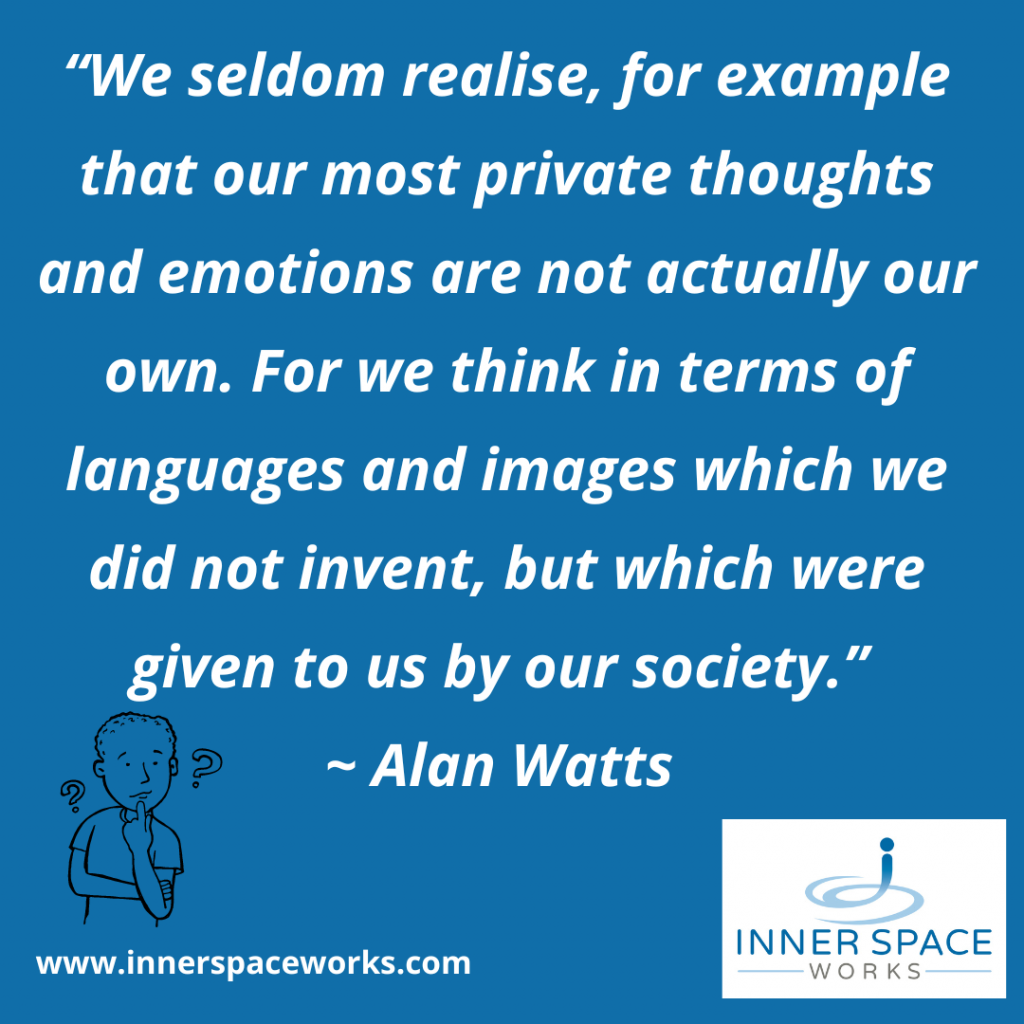
Better understanding our thoughts and feelings can take time. We first need to notice where the thoughts and feelings might be from.
It can be useful to understand that the confusion we often experience can be the conflict between what we TRULY believe in and what society EXPECTS of us.
Consider the time you last criticised yourself for doing something the wrong or for not being good enough at something – whose voice or words are they? A parent? grandparent? A bully at school or in the workplace? They may be someone’s but they’re probably not yours!
Learning to let go of other’s expectations of you and to recognise your own needs and wants can free you up to be your true, genuine self. This can lead you towards making choices to live the life you choose.
Mindfulness meditation training through a Mindfulness-based Stress Reduction (MBSR) course and / or counselling (talking therapy) can support you to do this.
As a Manager, Why Should I Focus on Staff Well-being?
Picture your ideal team member. They’re probably really engaged, open to new opportunities, use their initiative and collaborate well with their colleagues.
Now picture the opposite. Consider how unproductive your team might be if everyone is switched off, finding it hard to deal with challenges and lacking capacity to behave well towards their colleagues.
In the majority of cases, it’s not the work that’s behind motivation and emotional issues, it’s actually well-being. Consider how productive your operations would be if everyone was energised, engaged, open to opportunities, using initiative and collaborating.
When measures are put into place to encourage staff well-being, you start to move people towards this ideal. They feel valued, gain confidence and become empowered. The result is improved communication with colleagues and customers. As such, the investment in people enhances the work environment, boosts customer relations and aids business growth.
Staff Well-being: What does it Mean?
The importance of staff well-being has been bandied about for years, but what does it mean?
Well-being is when our psychological, physiological and social needs are met, allowing us to thrive. A Christmas party or a bonus in the pay packet can boost staff morale, but if your employees physiological, physical and social needs are not being met, the effect can be short-lived. We will explore these three components in more detail, but it is important to say that everyone is different so be aware that the priority of each need will be different for everyone.
The Three Components of Well-being
Well-being is less about something that happens to us and more about how we feel inside.
Psychological Needs
We need to feel safe, calm and in control to approach daily life with positivity and purpose.
When anxiety and fear are high, it is impossible to perform well. In fear mode, we lack focus, get easily confused and tend to act defensively. Psychological needs are all about the things that help us to mentally function well.
Physical Needs
Our bodies are complex machines which require the right fuel and maintenance to operate efficiently. They need plenty of hydration, nutritious food, regular exercise and adequate sleep to operate well.
When people feel under pressure or undervalued, poor habits begin to creep in. Skipping meals, comfort eating, working long hours and feeling too exhausted to exercise, all impact on the physical performance of the machine. And if the body isn’t humming, the brain can’t either so that in turn triggers the vicious circle that we’re then less likely to be able to meet our psychological needs too.
Social Needs
As human beings, we like to belong. We draw on the compassion, encouragement, fresh perspectives and shared experiences of time spent with others.
Social distancing has clearly shown how operating in isolation can have a detrimental effect on our confidence and mental health. A big part of social needs in the workplace is helping people to feel connected and valued by their colleagues.
Stress Management in the Workplace
Hopefully you can see now how the absence of well-being in your team can exacerbate or even create more stress. It is impossible to avoid stress altogether and some individuals are actually motivated by tight deadlines. The pressure of getting a big order out on time can build team spirit, collaboration and a sense of reward. Issues arise when the pressures are sustained and the three well-being needs are not being met.
As a manager, it can be difficult to know how to support everyone with stress management, especially as this can put you yourself under even greater pressure.
A solution is bringing an experienced mindfulness trainer into the workplace.
Mindfulness-based Stress Reduction(MBSR) is a series of workshopswhich encompasses the three elements of well-being and provides practical resources to improve them. Through exercises, mindfulness meditation practices, discussions and reflections, the training helps employees to understand their own needs and those of others within the team. The open and honest nature of the workshops encourages greater empathy and collaboration and this results in improved reliance, compassion and stress management.
Mindfulness for Returners to Work
When people are returning to the workplace, they will likely need greater reassurance to manage stress.
Currently, many employees are preparing to return after a period of furlough. Whilst we have all been affected by Coronavirus, our experiences have not been the same. Some staff may have enjoyed a break from the usual routine, others may have faced financial hardship, isolation, the loss of a loved one and uncertainty.
Even if you had a strong team at the start of the year, the pandemic could have rocked the boat. The MBSR course can be especially significant at this time, as a means of supporting everyone as they adapt to new ways of working and changes in their circumstances.If you would like to know more about this effective method of managing workplace stress, please contact Jo Clarke at Inner Space Works on 07889 295959 or info@innerspaceworks.com.
Being aware of what your body needs, physically is a good way of helping yourself through challenging times.
During this period of social distancing, you may find yourself working from home rather than the office. This could mean that you begin to feel the strain of sitting on an uncomfortable dining chair, staring at the laptop for hours on end, with the pressure to meeting deadlines with no team around you for support. You might feel tension in your body; shoulders, neck, and lower spine. At this point, as long as you are used to exercising in some way, it might be useful to do some kind of gentle stretching exercises. Within the PDF download, there is a link to a mindful movement called Qi Gong. This can be a very gentle but effective way of moving and tuning in to your body, allowing the blood to flow and the breath to lead the movement.
Until now, I was unaware that the NHS website also offers free resources for aerobic, pilates and yoga classes. The links for these are also within the PDF download.
Another important element of taking care of yourself physically, is your diet. Paying attention to what you are eating and when you are eating can help to improve medical conditions, digestive system and quality of sleep.
If you download the PDF, the links will take you to the NHS website and Inner Space Works website.
Choosing how you get through the next weeks and months is important and sometimes taking one day at a time is more than enough. This is not weak or failing. It takes strength and courage to acknowledge that you might need to temporarily slow down and perhaps ask for some support.
Dealing with practical tasks can be psychologically draining. Learning to take care of yourself and being kind to yourself is important (even though it may feel counter-intuitive!).
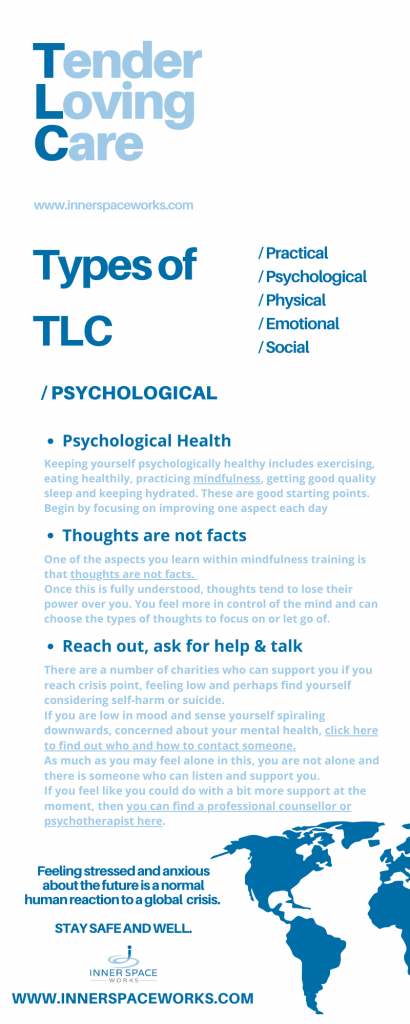
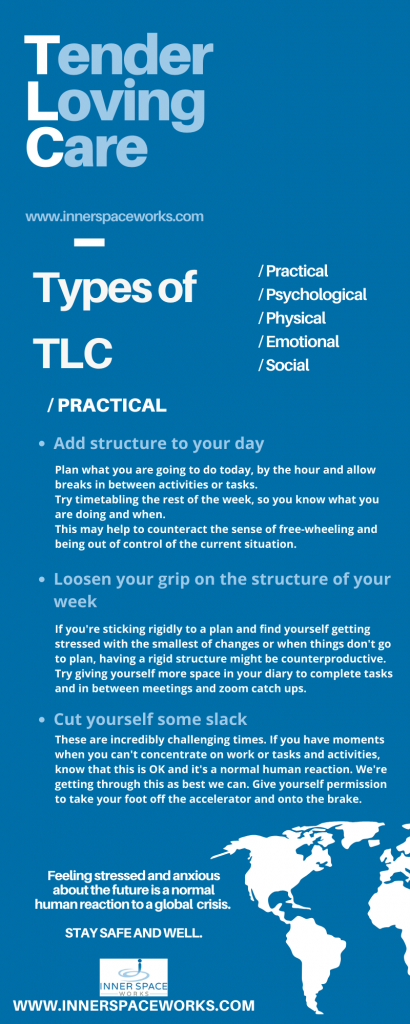
We all need it but do you allow yourself to think ‘out of the box’ or, when you look at the infographic below, do you only see the words “Loving” and “Care” and equate that to being soft and your brain switches off?
TLC is offering ourselves alternative ways of thinking and doing. New perspectives and approaches that may be useful, particularly whilst we are navigating our way through this Global Pandemic of Coronavirus, Covid19.
Life was tough, stressful and challenging before lock down. Now, we have layers of newly presented challenges.
Knowing that there are alternative ways of approaching tasks and situations can help us to manage the situation differently and perhaps to better manage ourselves.
Try offering yourself some TLC and see what happens. Below are a few suggestions for how you could change things up in a practical way.
Are you structured or unstructured in your approach?
Jon Kabat-Zinn created the Mindfulness-based Stress Reduction (MBSR) Course in 1979. Now, it is widely used as a method of calming the mind and body to manage our automatic, emotional reactions to external factors. Within this article, Kabat-Zinn explains the essence of mindfulness, learning to understand the relationship we have with pain; emotional and physical. The Mindfulness-based Stress Reduction (MBSR) Course is Secular, meaning that it is not related or connected to religion or spiritual practice.
“With others, he pioneered an eight-week mindfulness-based stress-reduction course at the University of Massachusetts Medical School for patients with chronic pain, harnessing the fundamentals of mindfulness meditation as taught by the Buddha, but with the Buddhism taken out. “I bent over backwards to structure it and find ways to speak about it that avoided as much as possible the risk of it being seen as Buddhist, new age, eastern mysticism or just plain flakey,” he says.”
“Kabat-Zinn had been meditating since 1965, but had no compunction in playing the Buddhism right down. “I got into this through the Zen door which is a very irreverent approach to Buddhism,” he says. He talks a lot about dharma, the term for the Buddha’s teaching, but he’s not a Buddhist and remarks that to insist mindfulness meditation is Buddhist is like saying gravity is English because it was identified by Sir Isaac Newton.”
“The UMass Stress Reduction Clinic opened its doors in 1979 and taught people with chronic back pain, victims of industrial accidents, cancer patients and sometimes paraplegics. Kabat-Zinn has defined mindfulness meditation as “the awareness that arises from paying attention, on purpose, in the present moment and non-judgmentally”. By focusing on the breath, the idea is to cultivate attention on the body and mind as it is moment to moment, and so help with pain, both physical and emotional.”
This crisis has caused us all to feel a level of distress, some more than others. Therefore, our bodies and minds are reacting. It makes sense and it’s rational, even though it can feel painful and disconcerting because there is tremendous suffering
The comments on some of my posts this week have shown that we all deal with crises differently and it’s important to acknowledge that what works for one does not work for another. Finding your own nourishing activities is most important during this time of self-isolation, as is finding your tribe.
For example, someone explained how they enjoy the idea of completing a puzzle to focus the mind. Someone else said that a puzzle was their worst nightmare and that they enjoy painting. I enjoy going for a walk along the canal (it is very quiet but I keep a 2 metre distance between myself and anyone else) and, I use mindfulness meditation throughout the day, both formally and informally to check-in with myself and to make decisions about how I should approach my day, tasks and activities. This makes us unique!
Emotions are Universal. We all have them; happiness, sadness, anger. What can be different, is the way we respond and react to them.
Mindfulness meditation can support us to self-regulate the body’s response (including the mind) to distress. Person-centred therapy can also be useful to process and overcome trauma.
It’s no wonder we’re all exhausted! – We are mostly caught up in cognition! Just reading through LinkedIn posts this morning – questions, answers, opinions, planning, doing, sorting, organising. I just wanted to shout out “STOP!!!!!!!!”
Cognitive processing; processing thoughts, busy-ness in the mind, layers of external input, interaction, distractions, reactivity. We need to do this to plan and complete tasks, but not ALL the time.
I have always been one of those people who could very easily keep going, like a Duracell Bunny but, when the batteries ran out, I’d be good for nothing! I have found the value of mindfulness meditation to be the ability of recognising my alert system, so I am alerted BEFORE the batteries run out!
I am interested in people and intrigued by what motivates individuals to keep going on and on…until burnout strikes. Better still, I am interested in guiding people through mindfulness training as a method of preventing burnout!
The value of mindfulness is also having the ability to become your own observer, noticing the black hole of depression approaching, which can prevent the downwards spiral. Or, noticing the build up of anxious thoughts and feelings, which can help to prevent a panic attack.
Please don’t get me wrong, I am certainly not on a “mindfulness solves all problems!” mission, but I always write and talk from my own personal experiences and those of my clients and scientific research. I appreciate that what suits one person may not suit another. However, I do truly believe that to understand whether something works for you or not, you need to experience in practice, not just from reading about it or theorising.
Through mindfulness training, the first and possibly most important element learned, is shifting out of the mind (cognition) and into the body (the felt sense). Within the Bodyscan practice, you learn to purposefully shift your attention around the body, each part in turn, and to be curious and interested. This can be an odd experience for some, and for others, it comes as a huge relief! Having a teacher to reflect your experiences with is useful and can be an important part of the training.
As I write this, I notice thoughts in my mind of how this may sound utterly crazy to some and why would anyone want to do this? People have better things to do with their time! The benefits of learning mindfulness can be practical and profound and, not always what you first imagine or expect. Be prepared to learn a new way of being human!
On a practical level, if you don’t like the idea of attending a group retreat or course, you can also learn how to integrate Mindfulness into your life with me, on a 1-2-1 basis, from the comfort of your own home via Zoom/Skype. If you’re intrigued but not yet ready to take the leap, take a moment to sit, with feet on the ground, body on a chair, hands resting on legs and breathing. Not needing to do anything other than to sit and observe.
How does that feel?
I have heard various responses during courses; horrendous, difficult, twitchy, “I can’t do it!”, relaxing, interesting, nice, a relief. Did you experience any of these or different?
Networking isn’t always the easiest activity. However, if you bring your true self to the meeting and you stay grounded and present (Mindfulness at play!), you can usually survive unscathed, or even have an enjoyable and useful experience!
Until yesterday, I hadn’t been to a networking event for a few months and this local Networking Lunch was my first opportunity to get back into the routine of putting myself out there. The #LinkedInLunch1 was organised by Angus Grady, who specialises in improving people’s LinkedIn profiles and teaching ways of utilising all the features of LinkedIn to market your services, products and business. Angus created a relaxed and open environment for us to do as much or as little networking as we wanted to. We were greeted by Jennifer who made us feel very welcome and who handed us our badges, explaining where the tea and coffee was and the format of the meeting.
This highlighted how important the greeting and welcome is to these kinds of events. It can be useful to put yourself in someone else’s shoes and consider the element of nerves when people are attending events, particularly for the first time (Levels of empathy can increase through mindfulness training, considering different perspectives and experiences). Jennifer’s professional and warm greeting definitely helped me to feel more relaxed and I was made to feel very welcome by Angus who approached me almost immediately afterwards to say Hi and thank me for coming.
Fortunately, I recognised a few friendly faces and so I made a bee line for the people I knew as I was interested to find out how they were. It’s interesting how a bit of familiarity can work wonders to make yourself feel comfortable and catching up with people who you care about and who care about you is good for your self-esteem! Had there not been anyone I knew, I probably would have found myself a seat, grabbed a cup of tea and begun to mingle (after taking a few internal mindful breaths to centre myself!) I found myself a seat and grabbed myself a cup of tea while James Pybus, a Digital Marketing Programme designer put up my advertising banner for me (I think he sensed my nerves as I was the only one who’d brought a banner – again empathy was offered)
During the meeting, we were invited to network, which was followed by an informative LinkedIn session with Angus, then lunch followed by more networking. I chatted with some really interesting people who I may be able to work with or refer other people to in the future but more than anything, I had some great conversations with really interesting people! Listening with curiosity to what other people offer, not only within their business but listening to the value they offer as a fellow human being can be incredibly rewarding!
Networking does not always have to be about the sell, it’s about forming and building relationships. The kind of work I do as a Mindfulness Consultant and Teacher, cannot involve pressurised selling. It’s a case of people becoming aware of the Mindfulness course I teach and how it is taught, either 1-2-1 via Zoom or 1-2-1 / group within organisations. The decision to take part in a Mindfulness course must be led by the person, not by me. You are the only one who knows what it is they need at any particular time and when you’re ready, you’re welcome to contact me for an initial chat or consultation. Mindfulness is a practical tool that can be used to self-regulate the body’s response to stress and to self-manage. It’s a different, healthy way of looking after yourself, in addition to exercising, sleeping well and eating nutritiously. Mindfulness practice leads us to a greater level of self-awareness, which can be empowering and liberating!
So, back to the networking meeting – If you are the kind of person who feels nervous before attending networking events or, you avoid networking events completely due to negative experiences, then this kind of networking might suit you. What’s really important to me, is that the meeting is informal. Angus made it clear within his LinkedIn post that this Networking lunch would not entail any pitches of any kind or formalities, but he encouraged people to mingle (if they wished to) and that he would be sharing some insights and tips on how best to use LinkedIn. The event was exactly what it said on the tin!
So, if you find yourself avoiding networking events, it might be useful to ask yourself why? What’s preventing you from attending networking meetings? Is it the 60 second pitch? Is it the fear of not knowing anyone or not knowing the venue?
Here are some practical tips;
1. Check where the venue is, before the day of the event. If you can take a drive to locate the venue or even go inside beforehand, it might help to make you feel more comfortable and confident on the day.
2. If you don’t like the prospect of walking into a room full of people, then arrive a bit before the start time so you are one of the first and can have time to speak to the organiser or facilitator.
3. When you arrive, orient yourself by either talking to the facilitator or, look for the toilets (very important if you suffer with nerves!), tea and coffee station and the layout of the room.
4. If the meeting is going to be seated at any stage, find a seat in the room where you feel most comfortable and place your coat etc. on the chair. That way, you can relax that you no longer have to search for a seat when it’s time to sit down. You can simply make a beeline to your chair.
5. Grab yourself a drink. Often, you’ll meet other people at the refreshments table who you can begin a conversation with.
6. Continue, in whatever way you feel comfortable. If you feel like taking a break from conversation, go and sit down. If you’re feeling overwhelmed or nervous, Mindfulness can be useful; ground yourself by focusing on each of these in turn; your feet on the floor, body on the chair, hands rested on the legs or each other, your breath. You don’t need to do any deep breathing, just pay attention to the breath in the body and notice any particular sensations in the body as you breathe. You can do this sitting down or standing up. You can even do this whilst you’re talking with someone else (they need never know!)
In situations like these, when we might feel nervous, overwhelmed or panicky. This is where Mindfulness can be incredibly practical. You can use Mindfulness to self-manage any or all of the following;
· Intrusive thoughts (e.g doubts, “I’m not good enough”, imposter syndrome)
· Uncomfortable feelings in the body (e.g swirling stomach, headache, feeling sick)
· Emotions that arise (e.g a sense of overwhelm, fear)
It doesn’t mean that the thoughts, feelings and emotions will go away, but mindfulness increases self-awareness, which can help to self-manage. Choosing a healthy coping mechanism like mindfulness practice can be a healthy alternative to those depleting activities that we cling to for comfort, like staying at home and not going out, drinking alcohol and comfort eating or, simply ruminating and riffing on unhelpful thought patterns.
Within Mindfulness practices, you learn each of the practices and then choose to focus on the breath, the body, sounds, emotions or thoughts. Whatever feels right for you, in any given moment. This can be discreet and no one else need know you’re practicing!
If there’s something that you want to be able to do and to enjoy but you’re experiencing blocks or find yourself repeating the same unhelpful habits, the MBSR course can be really useful. I say this because I have experienced it myself and, I continue to experience the positive benefits of mindfulness every day I practice and choose to live my life mindfully.